Showing posts with label if you like this try. Show all posts

Wednesday, January 29, 2014

If You Like This, Then Try...: A Dragon's Crown for Tiffany Aching

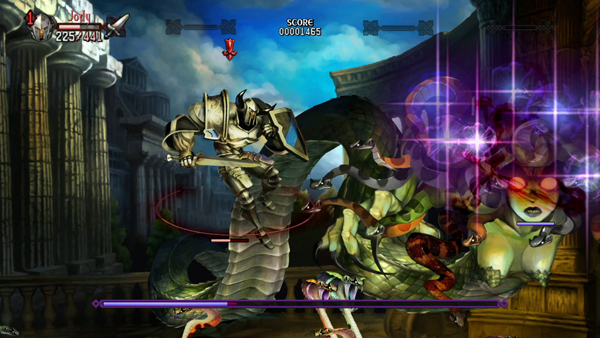
I’ve admitted it in the past and warn each of my students at the beginning of each new semester’s classes: I’m a nerd. As such, I tend to play some gooberish games--or at least some that aren’t in the limelight like Call of Duty or Halo or GTA. But they tend to be some of my favorites. One such game is Vanillaware’s Dragon’s Crown, released for both Playstation 3 and the PS Vita.

Basically, it’s an old-school hack ‘n’ slash like Golden Axe mixed with today’s RPGs customization, which allows you to level up, gain new abilities, and all that other nerdy goodness. The most striking feature about it, though, is the graphic style, as this company is known for hand painting every animation--from the backgrounds to the individual characters. It’s like playing a piece of artwork. Seriously, if you can get passed the ridiculous female character design, it’s one of the most gorgeous games you’ll ever see in action.

It’s your typical tale of epic treachery and wizards and witches and knights and kings and a deep-seeded evil that can destroy everything. You know, the same old, same old when it comes to fantasy. But if you’re looking to move beyond that typical story and delve a bit deeper into a wonderful world and one of the best freaking female protagonists ever, you need to check out Terry Pratchett’s Tiffany Aching series.

If any of you follow my Goodreads, you’ll be well aware of my love affair with Terry Pratchett and this series. As both are, indeed, among my favorites, so I can’t help but give them a further plug.

Starting with The Wee Free Men, we follow Tiffany through four books, as she grows from a girl just learning how to use her witchy-ways to a young woman that makes real decisions with no easy answers. Pratchett shies away from the major downfalls in the YA world’s female protagonists as Tiffany not only has a head on her shoulders, but she uses that head to solve problems, save lives, and keep the area she lives in, in balance. She doesn’t need a guy to make her happy or pull her from a tight spot. The most help she gets are from other empowered women that all preach the same message: Find your own way.

So, why am I discussing these two apparently disparate pieces of pop culture? Because they overlap in one key area: Both are chock full o’ humor and lean towards the lighter side of fantasy. Yes, there are witches and magic and such things in both, but both--especially the Tiffany Aching series--are accessible for anyone through their use of humor. Dragon’s Crown might not be laugh out loud funny like parts of Aching’s series are, but there is enough cheek and dry wit to keep you amused.

In the end, if you don’t mind a bit of fantasy, you can’t go wrong with either the game or the books. However, I will warn you that for every positive reinforcement that Pratchett creates for Tiffany and YA females in general, Dragon’s Crown upholds a very sexist presentation. I guess that’s what happens when the target audiences for both have extremely different demographics.

But, please, do yourself a favor and pick up the first book in Tiffany’s quadrilogy. You’ll be hard pressed not to fall in love.

Wednesday, June 26, 2013

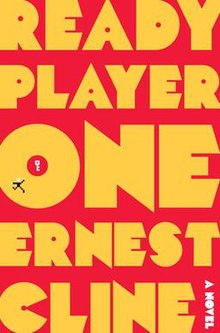
If You Like This, Then Try... Deltron 3030 and READY PLAYER ONE

Chris: Stay with me for a moment; I’m about to rant.

[Rant start]

I’ve always loved albums, their wholeness, even if I don’t like every track. I love their organization, when you see the purpose behind a slow song sandwiched by two blazing tracks, when a fantastic first track opens the door to this music hall, when a closing track completes your audio journey and--hopefully--forces you to hit play once again. Much as I’ve grown to embrace the digital world, to me, the biggest loss is that of the complete album. Now, you can simply purchase the track(s) you like and never even listen to the rest. I’ll admit, for most artists, that’s not a big deal. But with less folks purchasing full albums, the less likely an artist will put out a concept album--something already sparse. And I don’t know about you, but I love concept albums, and I’ll be sad to see a rarity become endangered in this digital age.

[Rant end]


Deltron's first album, "3030," released in 2000, is the mutated, hip-hop offspring of Del the Funky Homosapien, Dan the Automater, and Kid Koala, and is one of my favorite concept albums around.

The whole of the album paints a picture of the future, in the year 3030, as it follows the life of a upcoming emcee who wants to participate in an intergalactic rap battle. It tells his story from start to finish, taking an occasional detour for a skit or song that fleshes out this futuristic world. From homeless rantings to public service announcements to ads promoting colleges, these tracks build a bleak world, which shares enough similarities to today, that you can not only relate with, but it also becomes a viable future.

In between the world building, we follow Deltron 0, a former “mech-warrior that didn’t respect orders,” who dreams of winning the "instupicuous," Fantabulous Rap Battle Extravaganza. It’s a battle of “man vs. machine, machine vs. computer, computer vs. woman, woman vs. child.” The songs' story carries us through to the battle itself and the aftermath. It’s a technological rap through the future, with Del referencing Transformers, Strange Brew, MicroMachines, and countless other bits of pop culture. And the beats range from the traditional to the bizarre to the digital noise and quirks of the electronic world.

It’s been 13 years since its release, but it’s still as solid as ever. Even better, this past week, those of us waiting for the next album, “Phase II,” were given the first single, “City Rising from the Ashes.” So now is the perfect time to catch up with the Deltron world before the new album drops. And if you like it, you’ll also like READY PLAYER ONE by Ernest Cline.


Set in a much nearer future, 2044, the novel paints an even grimmer picture of what's to come. The general populous lives in the digital world of OASIS, an MMORPG (think World of Warcraft but not only for fun but how you also go to school, shop, work, etc.). Wade, the protagonist, spends his hours on the OASIS trying to solve the game creator’s puzzle. Years ago, the creator started a contest whose winner would inherit his mass wealth and control over the OASIS. Now, Wade must dodge evil-global corporations trying to win the contest while sifting through massive amounts of 80’s pop culture--from “Family Ties” to Oingo Boingo and Billy Idol to heaps of classic arcade games--to solve the creator's enigma. (The author even created his own soundtrack for the novel that you can find with a quick Google.)

While both READY PLAYER ONE and Deltron are very different in topic and execution, they share many similarities. Both have unlikely heroes trying to accomplish impossible tasks. Both are chock full o’ pop culture references to build their futuristic worlds. Both create their own vernacular for the future. And best of all, both are a shitton of fun and never take themselves too seriously.

If you’re a fan of Deltron, give READY PLAYER ONE a shot. And if you’ve been reading this and wondering what in the hell I’m even talking about, do yourself a favor and take a quick listen, and then go grab this novel from your local bookstore--especially if you’re into sci-fi, videogames, humor, and pop culture.

Wednesday, May 22, 2013

If You Like That, You'll Love This: The Unfinished Begins Where the Sidewalk Ends


Although this is the first poem in Shel Silverstein’s classic, Where the Sidewalk Ends, it could just as easily be an invitation to The Unfinished Swan (TUS). Available for download via the PSNetwork for Playstation 3 (sorry, all you Xbox folk), TUS is distributed by Santa Monica Studiosbetter known for their God of War series. And while you might not be tearing the heads off medusas or driving your sword down a minotaur’s gullet, TUS provides a gaming experience that’s so unique and gorgeous that you’ll forget all about that testosterone-charged Kratos.

TUS follows the story of Milo, a boy who has never known his real father and has recently lost his mother, a woman that painted often but never finished a single work. Forced to live in an orphanage, Milo only has room for one of his mother’s paintings and her special paintbrush. He takes her painting of a swan, which is—of course—unfinished. 
From The Unfinished Swan
From Where the Sidewalk Ends
On his first night away from home, the painting comes to life, the swan flying off the canvas and leading him to a faraway land, where we learn of The King, who built this world as he saw fit. You, as Milo, must navigate the bizarre landscapes, armed only with paintballs or water drops, splashing the pristine world so that this

becomes this.


As Milo navigates the world, we learn more and more about The King, his story, and how it relates to Milo’s. The story, however, is told in verse, with wonderful line drawings that make the whole game feel like an interactive storybook—a fact that the developer, Giant Sparrow, exploits even further by making the game menu look like a book, too.

Within minutes of playing the game and watching the first storybook scene, it’s easy to see similarities between TUS and the works of Shel Silverstein. From the story told in verse, to the—mostly—black and white drawings to the overall tone of the game, it feels like something Mr. Silverstein might’ve written—or, at the very least, played and enjoyed.


From Where the Sidewalk Ends
From TUS

Throughout the game, the story and narration feel playful and light, the verse adding to the levity. However, there is that darker undercurrent that’s found in much of children’s literature, particularly Silverstein’s. There’s that feeling of dread and darkness that lurks just below the surface, since as all children know—and adults seem to forget—the world can be full of beauty and also freak you the fuck out within the span of a few moments.

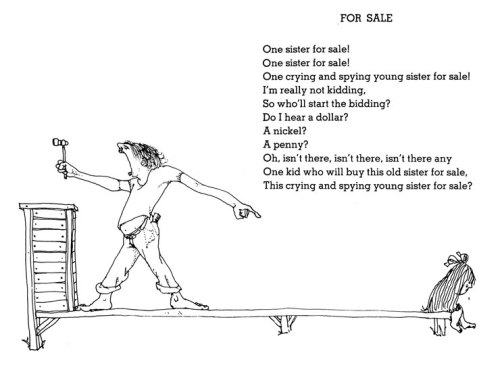
In essence, TUS feels like reading one of Silverstein’s verses, like “Lester,” where a boy spends his life wishing for wishes but never living, or “For Sale,” where a brother tries to sell his crying sister—or even an interactive version of The Giving Tree. These poems and stories are funny and poignant and heartbreaking all at once. The same can be said for TUS, as Milo’s story is a fantastic one of beautiful lands and an incredible journey, but one that’s tinged with sadness and darkness as well. Like the best and favorites of our childhoods, this game will linger longer after the final credits roll.


So, as most of this series of posts will go, the recommendations go both ways. If you grew up with and love Silverstein’s works, you will love the tribute that TUS creates (as long as you can handle the First-Person aspect of the game). And if you played through and enjoyed TUS, sit down and spend some time with Silverstein’s works; you won’t regret it.
From TUS